
EthicsPortal
EU whistleblower compliance infrastructure with flat pricing, Germany-hosted report data, and published procurement documents.
Rubric score
47 / 50
Evidence tier P+R+H
Reviewed across the public site plus the reporter and handler environments.
Facts
- Headquarters
- Poland
- Hosting
- Hetzner, Nuremberg, Germany (file attachment backup copy in Falkenstein, Germany)
- Pricing
- €60/month, or €41.67/month billed annually (€500/year)Single plan, unlimited users, reports and file uploads. A 30-day money-back guarantee is offered; there is no upfront free trial.
- Languages on reporting form
- 14
- Founded
- 2025
- Ownership
- Private
- Product scope
- Standalone whistleblower product
- Encryption posture
- At rest
Measured, not published
Established by checking the vendor's own infrastructure rather than by reading its marketing. Every figure here can be reproduced from the links given.
- DMARC policy
- Enforced (quarantine)
- DNSSEC
- Unsigned
Capabilities
- Anonymous reporting ✓
- Multi-channel intake ✓
- Public API ✗
- Free trial ✗
- Two-factor authentication ✓
- Audit log ✓
- EU Directive 2019/1937 (vendor claim) ✓
✓ published by the vendor · ✗ vendor states it is not offered · — not published either way
Certifications and national law
Certifications
- ISO 27001 (Hetzner hosting)
National laws referenced
- Germany (HinSchG)
- France (Loi Waserman)
- Italy (D.Lgs. 24/2023)
- Spain (Ley 2/2023)
- Poland (Act of 14 June 2024)
- Bulgaria (Whistleblowing Act, in force 4 May 2023)
- Greece (Law 4990/2022)
- Romania (Legea nr. 361/2022)
- All 27 EU member states — a dedicated /whistleblower-laws/<country>/ page exists per state, citing the official law text
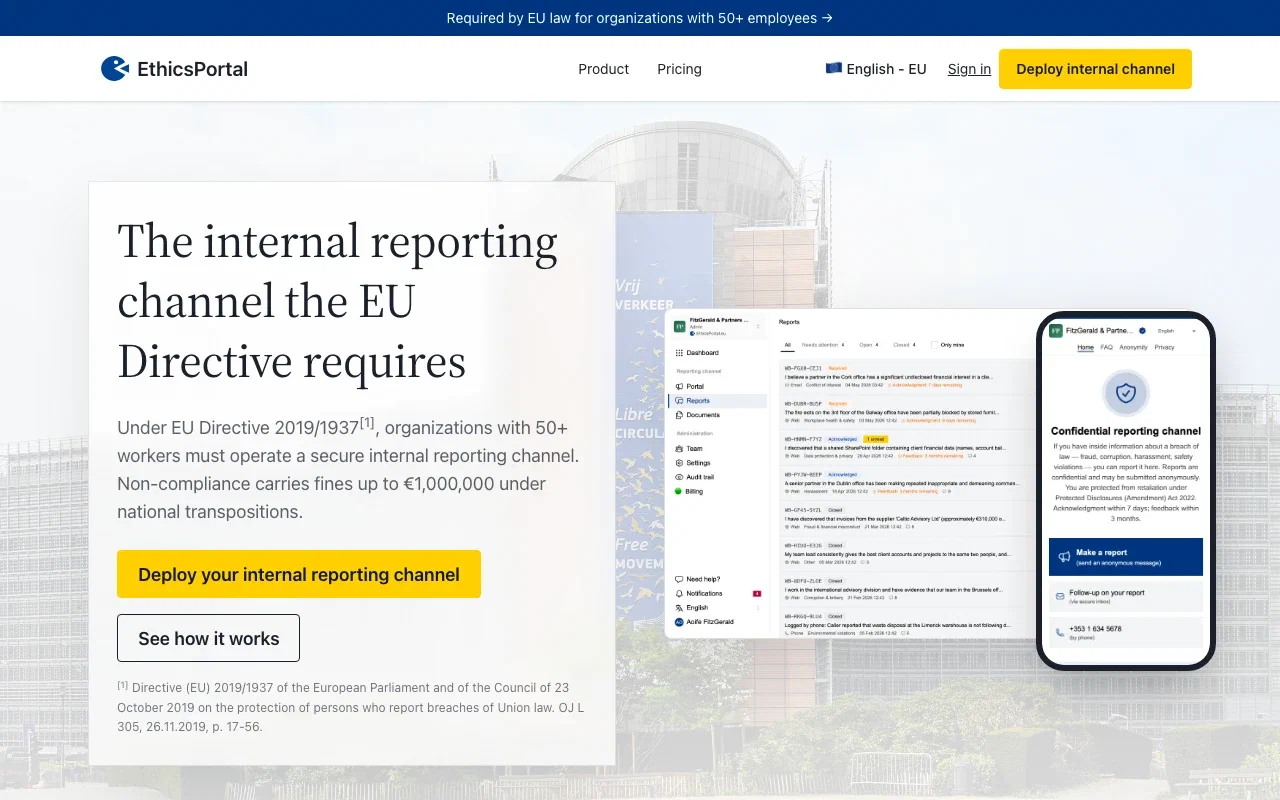
EU organizations seeking a whistleblowing channel with flat pricing, German report-data hosting and public procurement documents.
Distinctive features
- Flat EUR 60/month or EUR 500/year regardless of headcount, users or report volume
- EXIF, GPS, and author metadata stripped from uploads automatically
- Article-by-article mapping of features to Directive 2019/1937, plus a dedicated public page for each of the 27 EU member-state transpositions
- Written, voice and email reports, with voice disguised automatically
- Published DORA procurement materials with stated limitations; any additional contractual rights require a bilateral signed order
Notable
- Flat EUR 60/month or EUR 500/year, excluding VAT, with unlimited reports, users and file uploads. A 30-day money-back guarantee is offered instead of an upfront free trial.
- Reporter and handler interfaces are available in 14 locales: 13 EU official languages plus Luxembourgish.
- Reports can be anonymous. Reporters return with a Case ID and a password generated by the system to read updates and exchange messages with handlers.
- Online reporting supports written reports and voice messages with automatic voice disguise. Each whistleblowing channel also has its own email address: emails sent to it become reports, the sender’s address is not shown to case handlers, and the reporter receives a Case ID and password for the secure inbox. Handlers can also record reports received by phone, letter or in person.
- Case management includes assignments, priorities, internal notes, acknowledgement and feedback deadline tracking, an append-only audit trail and PDF case export.
- Report-file metadata is removed automatically. Sensitive report content and attachments are encrypted in transit and at rest.
- Closed-report retention can be configured for 12, 24, 36, 48 or 60 months, followed by automatic deletion.
- Two-factor authentication, single sign-on and automated identity-provider provisioning are available for organization teams.
- Core report data is hosted with Hetzner in Nuremberg, Germany, with file-attachment backups in Falkenstein, Germany. Hetzner’s infrastructure certification is separate from EthicsPortal: EthicsPortal does not hold accredited ISO 27001 certification.
- Public procurement materials include a DPA, a DPIA template, a subprocessor list, security policies, self-assessments and DORA materials with stated limitations. Self-assessments are not independent certification.
- The DPA provides breach notification without undue delay, 30-day notice of subprocessor changes and a right to object. Additional DORA contractual rights require a bilateral signed order.
Verification scope
This public profile restates the published product, pricing and procurement pages. It does not disclose internal implementation details. Its earlier reporter and handler review is distinct from this public-source refresh.
Frequently asked questions about EthicsPortal
Answers derived from vendor-published materials dated on this page.
Is EthicsPortal suitable for SMEs under 250 employees?
Which national whistleblower laws does EthicsPortal explicitly reference?
Does EthicsPortal process whistleblower report content with AI?
Similar to EthicsPortal
Other platforms in the directory with overlapping pricing model, certifications, or procurement path.
- SafeSpeak (Project Spire) Whistleblowing software from Estonia's Project Spire OÜ, with one flat-price plan.
 Ashio
Estonian-registered whistleblowing SaaS with 18 site locales, a law page per market, client-side encryption, and one €23–30/month plan that includes every feature.
Ashio
Estonian-registered whistleblowing SaaS with 18 site locales, a law page per market, client-side encryption, and one €23–30/month plan that includes every feature. EthicLink
Romanian self-serve whistleblowing SaaS from SELFSOFT TECH SRL. €30/month or €300/year, EU-hosted, 7-day free trial. No EU Directive or Law 361/2022 citation on the public pages reviewed.
EthicLink
Romanian self-serve whistleblowing SaaS from SELFSOFT TECH SRL. €30/month or €300/year, EU-hosted, 7-day free trial. No EU Directive or Law 361/2022 citation on the public pages reviewed. hintcatcher
German whistleblowing platform from product kitchen GmbH. Flat pricing from €39/month, independent of headcount.
hintcatcher
German whistleblowing platform from product kitchen GmbH. Flat pricing from €39/month, independent of headcount.
Sources and verification
Every fact on this page comes from EthicsPortal's own published materials. These are the pages that were read, and the date they were read.
- Last verified
18 of the vendor pages cited below has changed since this entry was verified. What this means
Cited pages last re-fetched
- ethicsportal.eu/directive-coverage/ (opens in new tab)
- ethicsportal.eu/ (opens in new tab)
- ethicsportal.eu/pricing/ (opens in new tab)
- ethicsportal.eu/product/ (opens in new tab)
- ethicsportal.eu/dpa/ (opens in new tab)
- ethicsportal.eu/dpia/ (opens in new tab)
- ethicsportal.eu/subprocessors/ (opens in new tab)
- ethicsportal.eu/trust/ (opens in new tab)
- ethicsportal.eu/security/ (opens in new tab)
- ethicsportal.eu/iso-37002/ (opens in new tab)
- ethicsportal.eu/iso-27001/ (opens in new tab)
- ethicsportal.eu/caiq/ (opens in new tab)
- ethicsportal.eu/dora/ (opens in new tab)
- ethicsportal.eu/dora-addendum/ (opens in new tab)
- ethicsportal.eu/industries/financial-services/ (opens in new tab)
- ethicsportal.eu/incidents/ (opens in new tab)
- ethicsportal.eu/accessibility/ (opens in new tab)
- ethicsportal.eu/whistleblower-laws/ (opens in new tab)